Big Fun Has Arrived in New Zealand All The Way From Australia
iscover distinctive, commercial-grade inflatables built for unforgettable events.
Few countries embrace the eccentric quite like New Zealand. Alongside bungy jumping, jet boating, and blackwater rafting, down-to-earth ingenuity in Aotearoa gave the world another offbeat thrill: zorbing.
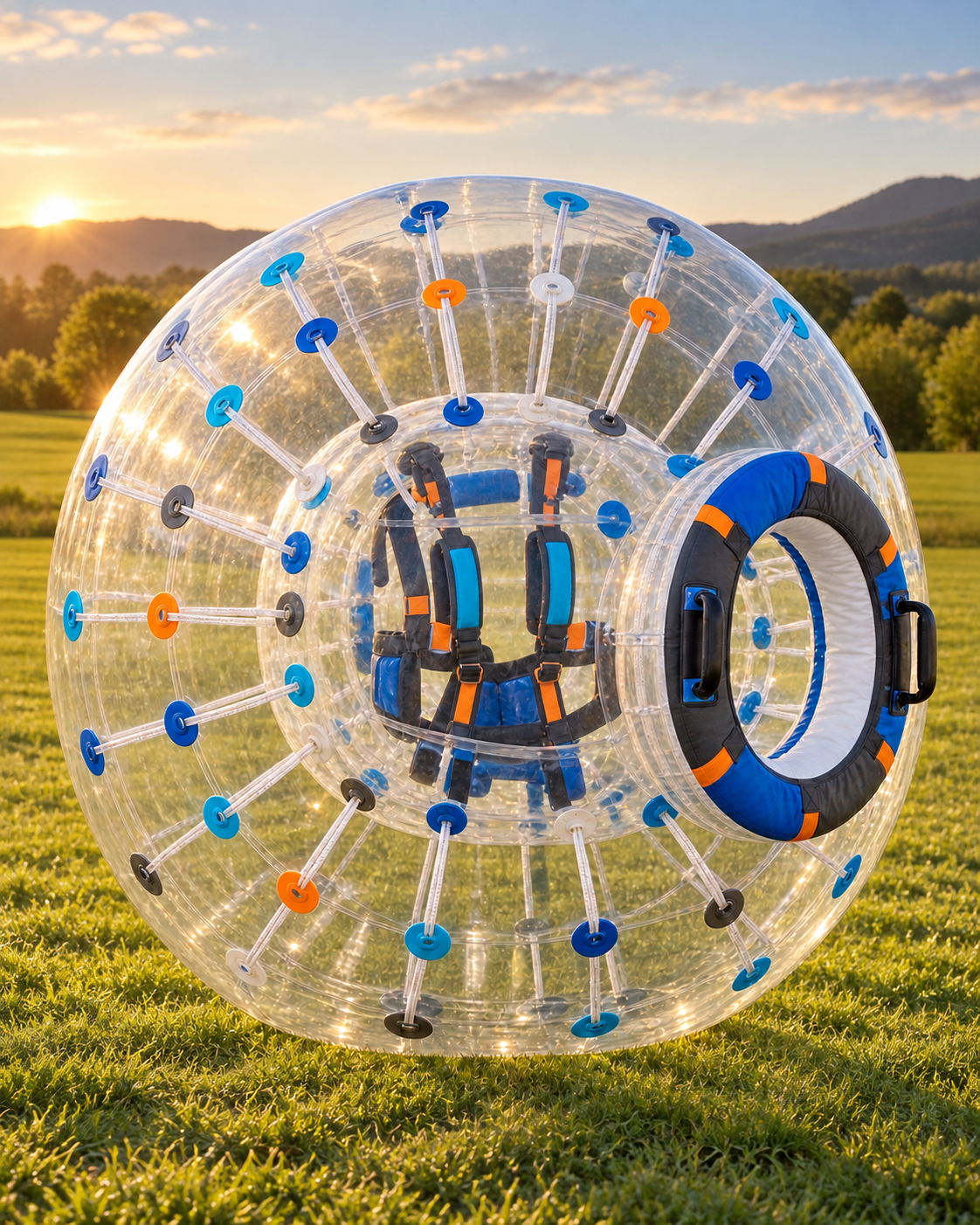
At its core, zorbing involves climbing inside a massive, double-walled inflatable globe and barrelling down a hillside. While it sounds like pure madness to the uninitiated, the Zorb ball has become one of the country’s quintessential tourism trademarks. It sits somewhere between an extreme sport, a theme park ride, and a human tumble dryer.
The story of the Zorb begins in the mid-1990s in Auckland. Two Kiwis, Andrew Akers and Dwane van der Sluis, were batting ideas back and forth about how to create an inflatable sphere that would allow someone to walk on water.
Working out of a suburban garage with sheets of plastic and heavy-duty welders, they soon realised a major snag: once you were out on open water, steering was virtually non-existent. As Akers later joked, there was a genuine risk a participant might simply catch a breeze and drift straight across the Pacific towards South America.
Instead of ditching the sphere, they looked towards New Zealand’s abundant rolling green hills. Rolling people down a controlled slope proved infinitely more thrilling—and vastly easier to manage. They trademarked the name ZORB, established commercial operations in 1995, and by 1997 had set up a permanent downhill site on the slopes overlooking Lake Rotorua. The word “zorbing” quickly entered colloquial Kiwi English and was formally inducted into the Concise Oxford English Dictionary by 2001.
To look at a Zorb from a distance, it seems like a straightforward, oversized beach ball. In reality, the engineering is precise, designed specifically to absorb heavy ground impacts while keeping riders secure.
      ______________________________________
      /                                      \
     |    [ Outer Sphere: ~3.0m - 3.2m ]      |
     |         Thermoplastic Polyurethane     |
     |                                        |
     |       ( 600mm - 700mm Air Cushion )    |
     |        Tensioned by nylon strings      |
     |                                        |
     |       [ Inner Capsule: ~1.8m ]         |
     |             Rider Chamber              |
     |                                        |
      \______________________________________/
Zorbing has evolved past a single downhill run into diverse recreational and commercial formats across the country.
Rotorua remains the heartland and exclusive home of commercial hillside zorbing in New Zealand. Operating on the volcanic slopes of Mount Ngongotahā, the official ZORB park runs purpose-built earthen tracks carved into the hillside.
Rides generally split into two distinct styles:
The Rotorua tracks cater to different thrill thresholds:
| Track | Length | Key Characteristics |
| Dual Straight | 250m | Smooth, fast, and side-by-side; built for straight-line speed runs and racing friends. |
| Sidewinder | 350m | The world’s longest track; weaves through six sweeping berms and high-banked corners. |
| Pipeline | 320m | Features sharp doglegs, weaves through tree-lined gullies, and finishes on a high half-pipe. |
| MEGA Track | 300m | The steepest and fastest layout on site, offering high drops and lake views before bottoming out. |
Outside fixed hillside venues, modified variants known as “Body Zorbs” or “Bumper Balls” are widespread across Auckland, Hamilton, Wellington, and Christchurch.
In this format, the inflatable sphere covers only the user’s upper torso and head, leaving the legs free to run. Participants play five-a-side football on community pitches, university greens, and sports centres. The game abandons conventional passing for high-impact checking, where players bounce off each other without risk of physical impact injuries.
Because water balls provide physical, low-consequence fun, mobile events businesses hire them out nationwide. Portable flat-ground tracks, obstacle courses, and sealed water rollers are staples of Aotearoa’s agricultural shows, regional A&P fairs, and secondary school leadership retreats.
New Zealand’s adventure tourism sector is governed by stringent workplace and recreational safety rules. The catastrophic accidents that occasionally hit unregulated, copycat zorbing operations overseas (such as instances in the Caucasus and Eastern Europe on open, unfenced ski pistes) prompted New Zealand operators to lead on safety engineering.
WorkSafe New Zealand monitors adventure activities through formal safety audits, operator registrations, and maintenance rules. Commercial tracks feature:
If you are planning to add zorbing to an Aotearoa holiday or road trip, keep these practical points in mind:
Zorbing encapsulates the self-deprecating, adventurous nature of Kiwi outdoor recreation. It wasn’t built inside an academic laboratory or commissioned by a corporate conglomerate; it was dreamt up by two mates tinkering in a shed who wanted to see what would happen if you threw caution and a friend down a hill.
Today, rolling down Mount Ngongotahā inside a slick bubble of water remains an unpretentious New Zealand experience. It is fast, silly, disorienting, and impossible to finish without laughing until your stomach aches.