Big Fun Has Arrived in New Zealand All The Way From Australia
iscover distinctive, commercial-grade inflatables built for unforgettable events.
Walk past an open reserve, a rural A&P show, or a school gala on a crisp Saturday anywhere from Northland down to Southland, and you will hear a distinct mechanical hum before you see anything else. It is the steady, thrumming roar of heavy-duty centrifugal blowers forcing cubic metres of air into stitched polyvinyl chloride.
Within minutes, an empty paddock or council park transforms into a labyrinth of towering obstacles, gladiator jousting rings, and sixty-foot slips.
Inflatables have come a remarkably long way from the saggy, unbranded square bounce houses of the late 1980s. Across New Zealand, inflatable entertainment has evolved from a novelty children’s birthday add-on into an indispensable, multi-million-dollar pillar of community recreation, corporate team-building, and commercial tourism. The way Aotearoa has embraced and adapted these air-filled contraptions speaks volumes about local culture: an instinctive fondness for physical rough-and-tumble, a relaxed community spirit, and an enduring willingness to look completely ridiculous in public for the sake of a laugh.
To understand how inflatables found such fertile soil in New Zealand, you have to look at the fabric of Kiwi weekend life. The community gala, the club rugby prizegiving, the church fair, and the local agricultural show are social institutions. Historically, these gatherings relied on coconut shies, sack races, and maybe a greasy pig chase if council bylaws had not yet caught up with animal welfare standards.
When commercial inflatables arrived in force during the late 1990s, they fit straight into this landscape. But what started with rudimentary bouncy castles quickly diversified into competitive physical challenges. Kiwis did not just want to jump up and down; they wanted to compete against their mates.
The hiring market quickly flooded with interactive game platforms:
+-------------------------------------------------------------------------+
|                  THE EVOLUTION OF KIWI INFLATABLES                      |
+-------------------------------------------------------------------------+
|  1980s–1990s       Early 2000s          2010s               2020s+      |
|  Basic Bounce  ->  Sumo Suits &     ->  Wipeout Courses ->  Massive     |
|  Houses            Bungee Runs          & Bubble Soccer     Aqua Parks  |
|  (Kids only)       (Adults join in)     (Corporate/Events)  (Lake/Sea)  |
+-------------------------------------------------------------------------+
These designs resonated because they flattened hierarchy. At an end-of-year corporate do in Auckland or Christchurch, an inflatable gladiator podium is the great equaliser. A junior apprentice can legally clout a managing director off a rubber pedestal with zero HR repercussions, all to the raucous cheers of colleagues nursing lukewarm cans of craft beer.
Then came the sumo suits—cumbersome, high-density foam monstrosities covered in wipe-clean vinyl that turn athletic adults into waddling, top-heavy bowling balls. The rules were simple: push the other person out of the ring or trip them until they flail helplessly on their back like an upturned beetle. It suited the self-deprecating Kiwi humour to a tee.
While dry land inflatables found steady homes at sports clubs and council parks, New Zealand’s geography created the perfect conditions for a secondary, even more spectacular evolution: open-water inflatable water parks.
Blessed with thousands of kilometres of sheltered coastline, expansive crater lakes in the Central North Island, and glacier-fed waterways throughout Otago, Kiwi summers are intrinsically tethered to the water. In the mid-to-late 2010s, commercial operators realised that modular, sealed-air commercial inflatables could turn quiet bays and lakes into temporary aquatic theme parks.
Ventures like Kiwi Water Park on Lake Dunstan in Central Otago, alongside seasonal operations across Lake Taupō, Rotorua, the Bay of Plenty, and Auckland’s northern beaches, introduced a style of obstacle course previously seen only on television shows like Wipeout.
These are not your garden-variety pool toys. Manufactured from 0.9mm UV-treated PVC tarpaulin with commercial-grade thermo-welded seams, these mega-structures feature:
                  TYPICAL AQUA PARK ANCHORAGE RIG

       Floating Inflatable Module (Drop-Stitch / PVC)
    ~~~~~~~~~~[=================================]~~~~~~~~~~ Waterline
                     |                   |
               Elastic Bridle       Elastic Bridle
                     |                   |
               Stainless Chain      Stainless Chain
                     |                   |
             (Concrete Anchor)   (Concrete Anchor)
                 Lake Bed            Lake Bed
These floating courses provide an intense physical workout. Hauling oneself out of deep freshwater onto slick, sun-warmed vinyl requires significant upper-body strength, yet the risk profile remains low. If you lose your footing on a narrow balance beam, you do not hit the pavement; you plunge straight into refreshing, crystal-clear lake water, surfacing in an approved lifejacket before scrambling back onto the ladder for another round.
For regional economies, these installations have been a bonanza. They require minimal permanent shoreline infrastructure, can be decommissioned and safely packed into shipping containers at the onset of autumn frost, and serve as irresistible magnets for domestic holidaymakers doing the classic Kiwi summer road trip.
Operating inflatable attractions in New Zealand is not as straightforward as rolling out a canvas mat, turning on an electric pump, and taking hire fees. The local environment presents specific operational hurdles that separate serious, safety-conscious commercial operators from amateur backyard outfits.
First and foremost is New Zealand’s notorious ultraviolet index. The ozone layer over the South Pacific is thinner, meaning the sun bakes synthetic materials with ferocious intensity. Inflatables that might survive five seasons in the United Kingdom or Germany can suffer catastrophic fabric fatigue and seam degradation within two years in Hawke’s Bay or Northland if they are not crafted from premium, UV-stabilised PVC. High-end hire firms must invest heavily in marine-grade canvas and certified flame-retardant, high-tensile materials to avoid catastrophic blowouts during midday heat.
Then there is the wind.
New Zealand sits squarely in the Roaring Forties, where maritime weather changes in the blink of an eye. A tranquil morning in the Wellington region or Canterbury can transform into a howling nor’westerly gale within twenty minutes. An inflated obstacle course presents a massive surface area to oncoming wind—effectively acting as a giant spinnaker sail.
Because of this, New Zealand adheres strictly to standards governing land-borne inflatable amusement devices (primarily standard AS 3533.4.1, recognised and enforced under the watchful eye of WorkSafe New Zealand).
Under these rules, proper anchorage is non-negotiable:
| Operational Parameter | Regulatory & Engineering Standard |
| Maximum Operating Wind Speed | Typically 38 km/h (Force 5 on the Beaufort Scale); strictly evacuated above this threshold. |
| Anchor Point Loading | Must withstand a direct pull force of at least 1.6 kN (approx. 163 kgf) per anchor point. |
| Ground Stakes | High-tensile steel, minimum 16 mm diameter and 380 mm length, driven at a 45° angle. |
| Hardstand Anchorage | Weighted water barrels or concrete counterweights calculating the exact overturning moment; pegs can never simply be omitted on asphalt. |
| Internal Air Pressure | Maintained consistently between 1.0 and 2.5 kPa to prevent structural collapse under adult load. |
Professional Kiwi hire companies carry anemometers to monitor gusts on-site. The tragic international accidents involving bounce houses carried aloft by sudden thermals have resulted in Kiwi councils and event organisers clamping down hard. Today, a council permit for a public event in Auckland, Hamilton, or Dunedin requires a certified safety plan, test tags on every commercial electric blower, and public liability insurance reaching well into the millions.
Beyond community fairs and corporate events, inflatables have filtered deep into grassroots sport and physical education.
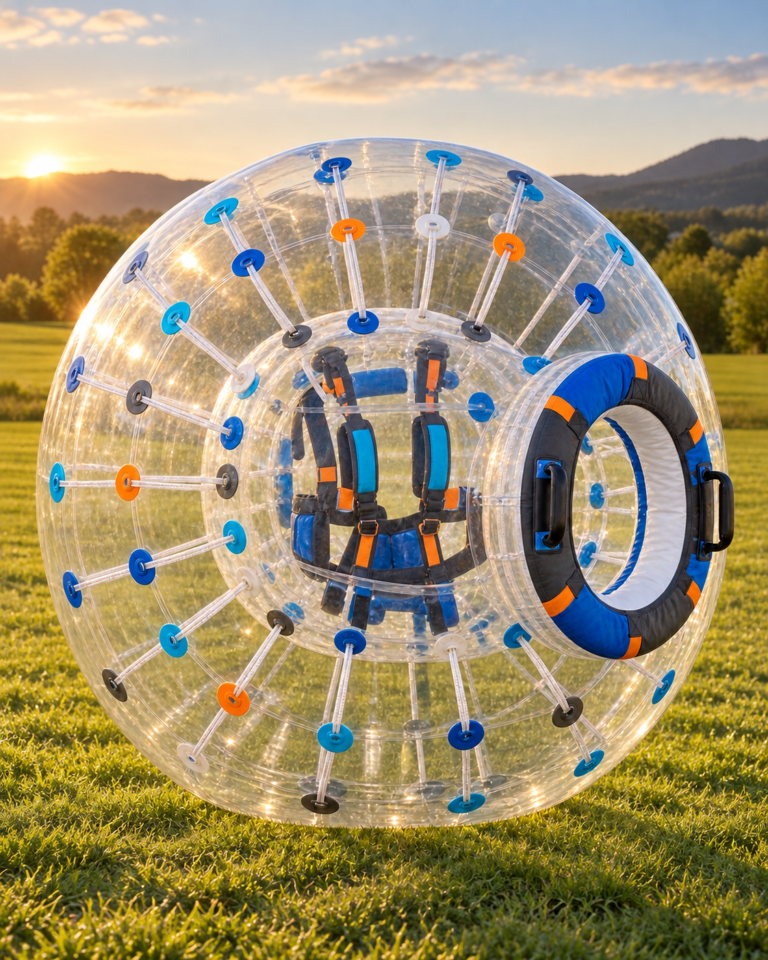
One of the most popular iterations over the past decade has been Bubble Soccer (or Zorb Football). Originating from the wider sphere of extreme zorbing—an activity famously invented right here in Rotorua by Andrew and David Akers in the 1990s—bubble football encases a player’s entire torso and head in an inflatable TPU (thermoplastic polyurethane) sphere, leaving only their legs free to run.
The sport quickly abandons any tactical nuance. Games played across community gymnasiums and high-school pitches descend almost immediately into full-body, bumper-car style collisions. The beauty lies in the energy dispersion: two players can sprint at one another at top speed, collide head-on, rebound four metres through the air, roll back onto their feet, and keep chasing the ball without a scratch.
       BUBBLE SOCCER COLLISION DYNAMICS

   (Runner A) ->                      <- (Runner B)
   +-------------+                  +-------------+
   |  ( O . O )  |                  |  ( > . < )  |
   | [Air Shield]|  ==== IMPACT === | [Air Shield]|
   +-------------+                  +-------------+
         | |                              | |
      (Legs)                           (Legs)

   Result: High kinetic energy, zero impact trauma.
Inflatables have also redefined the modern charity fun run. Events like the Monster Slide—a 300-metre vinyl slip-and-slide routed down steep city streets in places like Dunedin or central Whangārei—and muddy obstacle races such as Tough Guy and Gal frequently integrate massive inflatable walls, hurdles, and foam-filled tubes into their cross-country courses.
Rather than relying purely on grueling military-style obstacles like barbed wire and timber scaling walls, organisers use inflatable components to keep the atmosphere lighthearted. It transforms what would otherwise be a punishing 10k trek into a festive romp where parents, school sports teams, and weekend warriors tackle absurd obstacles together in muddy tutus.
Why do inflatables hold such an enduring appeal in New Zealand?
A great deal of it comes down to Kiwi social mores. In a culture that traditionally prides itself on being grounded, humble, and unpretentious, high-society entertainment has never quite fit comfortably outside narrow circles. We prefer entertainment where nobody can maintain an air of dignified superiority.
You cannot look dignified crawling on hands and knees through an inflatable tunnel, getting stuck in an oversized donut hole, or taking a foam pugil stick to the ribs while dressed in head-to-toe yellow padding. Inflatables demand vulnerability. They force participants to surrender their adult self-consciousness and return momentarily to childhood roughhousing.
Furthermore, they provide a safe venue for physical contact in an increasingly litigious, risk-averse world. On an inflatable mattress, an adult can sprint as fast as they can and throw themselves into a horizontal dive to intercept an opponent, knowing the worst consequence is likely a mild friction burn on an exposed elbow or a temporary loss of breath from laughing too hard.
From tiny school galas on remote West Coast beaches to vast floating water parks on the azure waters of Central Otago, inflatables have firmly established themselves as an integral part of how Kiwis play. They are loud, colourful, physically demanding, slightly unhinged, and thoroughly grounded in community fun—much like the country itself.